
Technical Hub
Resource Library
The resource library is intended to demonstrate how to assemble Seawise products most efficiently.

Waterloc Assembly
.png)
Thermoloc Insert
.png)
Coldloc Bag Assembly
Product Catalogue
Packaging Systems by Seawise offer a complete replacement for Styrofoam and wax packaging in both secure and unsecure cold-chain distribution.
The patented Thermoloc™ insulating liner derived from recyclable LDPE, out-performs EPS/ Styrofoam at half inch thickness.
Waterloc™, designed as a wax replacement, is built for wet environments and can contain water without compromising strength.
Waterloc™ and Thermoloc™ combined offer a complete replacement for Styrofoam.


Regulatory mandates move North America toward sustainable packaging
According to the Association of Plastic Recyclers, across Canada and the United States, several states and provinces have enacted or are in the process of implementing regulations that aim to reduce plastic waste. These regulations include bans on specific materials, such as expanded polystyrene foam, known and Styrofoam. Additionally, the introduction of Extended Producer Responsibility (EPR) programs have placed the responsibility for the entire lifecycle of packaging, from production to disposal, on the producers of the product being packaged and distributed. Producers who are not exempt from the new laws have actively sought out, or are in the process of seeking out, sustainable packaging alternatives, such as recyclable or compostable products.
In the United States, EPR laws exist in California, Colorado, Maine, Oregon, New Jersey, Minnesota, and Washington. In Canada, established EPR laws exist in British Columbia and Quebec, with most provinces doing a full transition to EPR between 2025-2027.

Styrofoam bans create strong incentives for packaging alternatives in the seafood industry
Reported by SeafoodSource as early as 2022, a growing number of U.S state and municipal bans on expanded polystyrene (EPS) have been forcing seafood shippers to seek alternatives. EPS, commonly known as Styrofoam, is traditionally relied upon in the seafood industry for its low cost, water resistance, and insulation capabilities. However, Styrofoam comes with negative environmental impacts, such as long decomposition time, and chemicals and micro-plastic debris that have negative side effects long after they’re discarded. Companies have switched to recyclable or compostable products that can perform in wet conditions and provide the correct thermal and barrier properties. The transition has provided opportunity for innovation and a progressive shift in the industry.

Canadian businesses should prioritize elimination, reduction, re-use
The Canada Plastics Pact’s 2025 guidance advises Canadian businesses to eliminate unnecessary and problematic plastics, and then innovate to ensure that the plastics we do need in circulation support reduction, re-use and recycling efforts. Problematic plastics are items that are not recyclable and don't have an efficient system or infrastructure in place for product end-of-life.
Prioritizing upstream innovation, and using smart design to avoid single use plastics, needs to be the focus for Canadian businesses. The golden design rules guidance document provides priorities for packaging design, including elimination of problematic elements like EPS, increasing recycling value of packaging, and improving environmental performance of B2B packaging, such as using Post-Consumer Recycled materials (PCR) where available.

EPS is a “waste nightmare”
EPS, or Styrofoam, is a popular choice in the seafood industry and is used for buoys, food packaging, the interior of pontoons, marina platforms, and more. However, it is not very durable and easily crumbles into smaller pieces. Concern is growing about mico-plastic debris left behind by Styrofoam packaging long after it is discarded.
An article from Global Seafood Alliance notes that while EPS is recyclable, it is rarely recycled appropriately due to its high volume to weight ratio; without being crushed it takes up a lot of space and creates challenges for the seafood industry. Transportation to recycling infrastructure is not always economical for those responsible. Additionally, once Styrofoam has been contaminated with seafood, mechanical recycling is less of an option, and chemical recycling is not available at scale. Therefore, companies paying EPR fees are highly motivated to make the move to more sustainable alternatives.
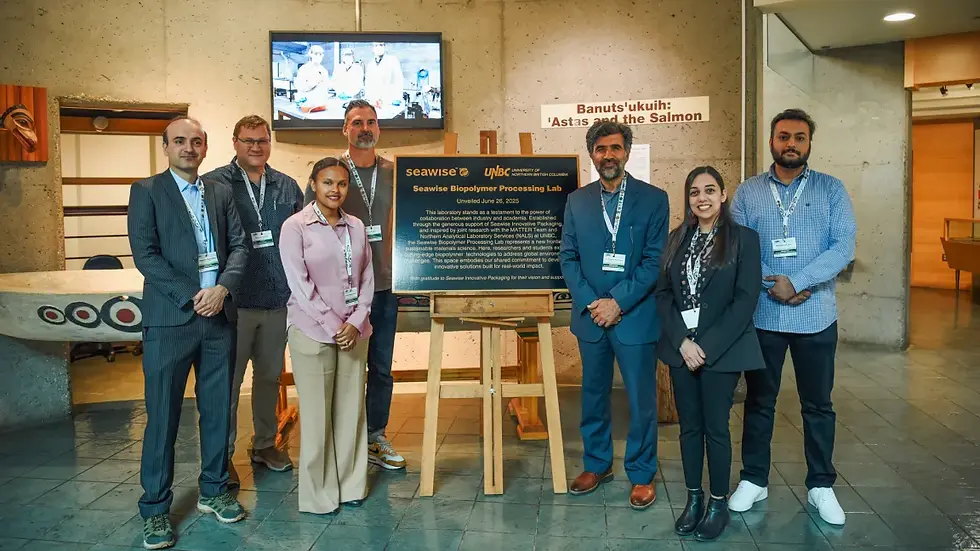
Academic-industry partnership is advancing development of sustainable packaging
The University of Northern British Columbia (UNBC) has unveiled the Seawise Biopolymer Processing Lab on its Prince George campus, recognizing a significant contribution from Seawise and our co-innovation partner Brown’s Bay Packing Company. The state-of-the-art facility, equipped with a $350,000 extruder and supporting equipment, is UNBC's first dedicated to producing plant-based biopolymer samples. The lab aims to advance research into sustainable materials, particularly in developing eco-friendly packaging solutions as alternatives to conventional plastics and polystyrene foam (EPS), or Styrofoam.
Alongside co-innovation partner Browns Bay Packing, the lab was instrumental in engineering the recyclable version our thermal liner, Thermoloc. Members of the Material Technology Environmental Research (MATTER) team at UNBC are working on a compostable version of Thermoloc.
Industry Scan
Regulations and costs are driving aquaculture and seafood operations in North America to adopt products that reduce plastic waste, promote circularity, and have a lower carbon footprint.